
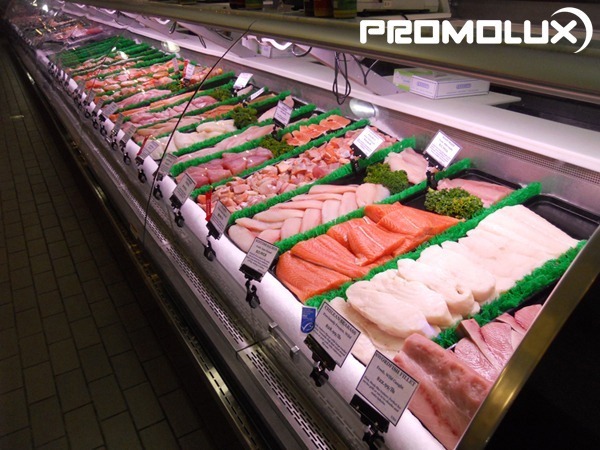
What Is Perishable Shrink?
In high-traffic categories like meat, dairy, seafood, and produce, shrink can account for 2–5% of sales, or even more in poorly managed departments.
While most retailers blame handling errors or poor temperature control, lighting spectrum and intensity often go unnoticed as major contributors to spoilage and shelf life reduction.
In the world of supermarket refrigeration, conversations around shrink often focus on inventory control, spoilage, or improper temperature settings. However, there’s a critical but under-discussed factor contributing to product loss and energy waste: the role of in-store lighting.
Improper lighting—especially high-intensity LEDs or legacy fluorescent systems—does more than just illuminate your fresh food displays.
This blog explores how lighting directly impacts perishable shrink and cooling overcompensation, and what retailers can do to reduce both.
How Lighting Creates a Hidden Heat Load
Lighting systems—especially those with strong blue and UV wavelength emissions—do more than simply make displays look brighter. They also:
Emit radiant heat, raising micro-temperatures inside display cases.
Accelerate photooxidation, particularly in protein- and fat-rich items.
Force refrigeration systems to compensate by cycling more frequently, increasing wear and energy consumption.
Even LED systems, which are marketed as energy efficient, can create a phantom thermal load if their spectrum isn’t optimized for fresh food.
Example of Overcompensation:
A dairy case with bright, unfiltered LEDs might experience:
- Slight increases in ambient product temperature (0.5–1.5°C)
- Faster vitamin degradation (especially riboflavin)
- More frequent compressor activation
- Early spoilage, requiring markdowns or disposals
These effects often trigger staff to lower the setpoint on the case thermostat, unknowingly forcing the system into a cycle of overcooling and overcompensation.
Lighting’s Role in Food Appearance and Sellability
In addition to temperature effects, lighting directly affects visual quality—a key factor in consumer purchasing decisions.
It exaggerates surface dryness, especially in deli products.
It causes certain fats and pigments to oxidize faster, resulting in off-odors or stale taste.
Studies show that 60% of shoppers base freshness judgment on appearance alone. If lighting prematurely dulls the look of a product, it may be discarded even while still safe to eat.
Layout Design Strategies to Control Traffic Flow
Improving traffic patterns doesn’t mean restricting access—it means intelligently directing flow to minimize cold air loss. Here are some practical tips:
- Avoid Placing Refrigerated Cases at Entrances:- Entryways bring in outside air. Positioning sensitive open cases away from these zones helps prevent immediate thermal impact.
- Widen High-Traffic Aisles:- Narrow aisles concentrate warm air and customer movement near the cold case. Providing wider lanes helps disperse air movement and reduce warm air infiltration.
- Segment Hot Zones from Cold Zones:- Avoid placing hot bars, ovens, or coffee stations near refrigerated sections. Heat-emitting zones near cold displays create localized thermal challenges.
Cooling Overcompensation: The Domino Effect
Once lighting causes product temperature spikes and spoilage signals (like discoloration or off-aromas), operators respond by lowering setpoints or extending run times on refrigeration systems.
This creates a domino effect:
- Lighting warms product zones slightly.
- Product quality declines → More spoilage.
- Operators adjust cooling settings → More energy use.
- Increased compressor wear and maintenance.
- Higher utility bills and carbon emissions.
This is what we call cooling overcompensation—an unnecessary escalation driven by the misunderstood impact of lighting.
SafeSpectrum™ Lighting as a Smart Solution
Its optimized spectrum minimizes high-energy wavelengths that contribute to both:
- Thermal load
- Nutrient and pigment degradation
Key benefits of SafeSpectrum™ lighting:
Lower radiant heat emission → Less microclimate disruption.
Protects pigments and fats → Reduces spoilage and discoloration.
Reduces refrigeration demand → No overcooling needed.
Improves visual appeal → Products look fresher, longer.
By stabilizing the display environment, SafeSpectrum™ helps prevent overreactions in cooling strategy—saving both product and energy.
Real-World Retail Impact
Sustainability Benefitst
Implementation Tips
To minimize shrink and cooling overcompensation, retailers should:
- Audit lighting types in all refrigerated zones.
- Monitor product temps, not just air temps, in open and closed cases.
Sustainability Benefits
Real-World Retail ImpactReal-World Retail ImpactReal-World Retail ImpactReal-World Retail Impact
Implementation Tips
To minimize shrink and cooling overcompensation, retailers should:
- Audit lighting types in all refrigerated zones.
- Monitor product temps, not just air temps, in open and closed cases.
Final Thoughts
Lighting is often treated as a visual necessity, but it’s also a thermodynamic force that shapes both energy efficiency and product longevity.
By switching to SafeSpectrum™ LED lighting, supermarkets can:
- Prevent unnecessary cooling overcompensation
- Reduce perishable shrink
- Lower utility bills
- Support food safety and freshness
In short, smart lighting protects both your product and your profit margin.
Learn more about SafeSpectrum™ lighting for shrink reduction and energy optimization:
www.energy-savings-refrigeration.com
